Welcome Customer !

Membership

Help

Chengdu Feichuang Technology Co., Ltd
Custom manufacturer

Main Products:

intelligent-mfg>Products

Chengdu Feichuang Technology Co., Ltd

  • E-mail

    sales@filtrascale.com

  • Phone

    15882220395

  • Address

    Unit 2, Building 2, Shiyong International Building, No. 68 Chenghong Road, Chengdu, Sichuan Province

Contact Now

Photovoltaic electrocoagulation and artificial wetland water treatment technology

NegotiableUpdate on 08/14
Model
Nature of the Manufacturer
Producers
Product Category
Place of Origin

Overview

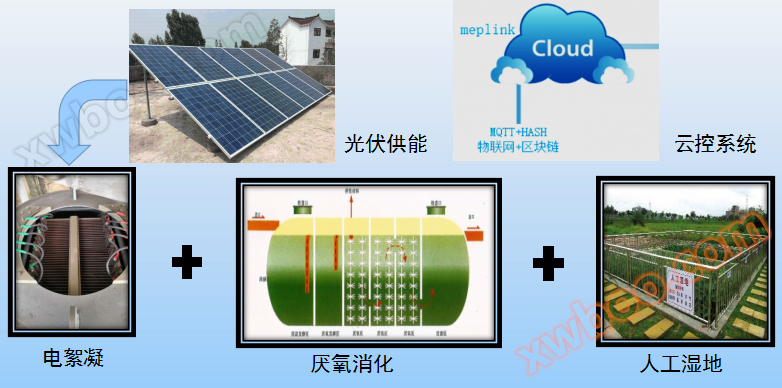
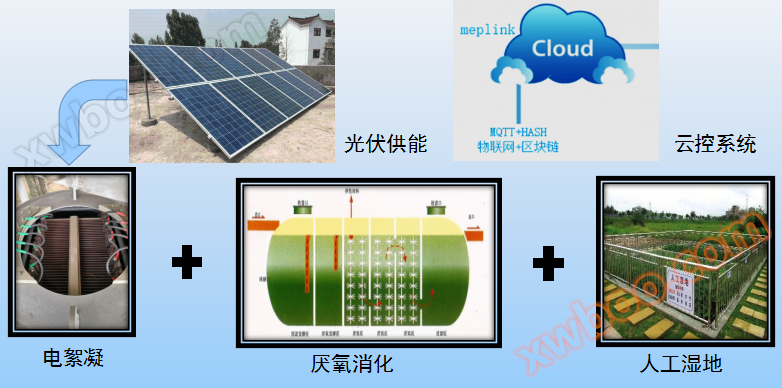
The main content of the case is a sewage treatment plant with a processing capacity of 50 tons/day, and the water quality meets the Class A standard of the "Pollutant Discharge Standards for Urban Sewage Treatment Plants" GB18918-2002. The project adopts electric flocculation anaerobic artificial wetland technology, which is mature and stable, operated in a foolproof manner, easy to manage, does not require dedicated personnel to be on duty, has low power consumption (photovoltaic power supply), no sludge generation, and is dispersed (single unit, multi unit)

Product Details


The current situation of water pollution in rural areas of China

With the rapid development of rural economy, the discharge of domestic sewage in rural areas has increased, leading to a worsening of the environmental conditions in rural areas. The quality of rural environment has significantly declined, directly threatening the living environment and physical health of the vast number of farmers, and restricting the healthy development of rural economy. The environmental conditions in rural areas are worrying. 96% of villages in China do not have drainage channels and sewage treatment systems, and production and domestic sewage are discharged arbitrarily. 89% of villages pile up garbage in front of and behind houses, along roadsides and even in water sources, floodways, and ponds inside and outside the village, with no one responsible for garbage collection and disposal. At present, more than 25 million tons of domestic sewage are directly discharged into rural areas nationwide every year, causing pollution of rivers and ponds, affecting the living environment of villagers, and seriously threatening the health of farmers. The characteristics of rural sewage treatment are firstly low treatment rate, secondly intermittent discharge with small and scattered discharge, thirdly high nitrogen and phosphorus concentration and containing a large amount of nutrients, bacteria, viruses, etc., all of which bring certain difficulties to the collection and treatment of rural sewage.

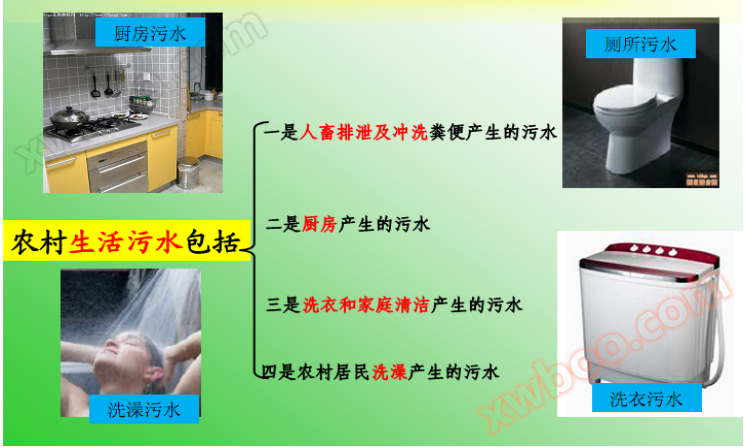
Rural sewage sources

image.png

Comparison of commonly used rural sewage treatment technologies

Technical Name advantage disadvantage
Three format septic tank-Constructed wetland Small footprint and easy maintenance Small scale sewage treatment
Anaerobic tank-Facultative filter tank Less investment, simple maintenance Regular replacement of filter media is required
Anaerobic hydrolysis tank-Oxidation pond-Ecological Gully Less investment, simple maintenance Regularly and timely harvest aquatic plants
Composite media biofilter High efficiency, simple maintenance, low investment, and small footprint Summer has a strong odor and requires regular replacement of filter media
Integrated sewage treatment technology Good effect, small footprint, arbitrary combination, remote control, high investment Regular replacement of membrane materials is required
A2/O-Constructed wetland Small footprint, high efficiency, mature operation The operation management technology is relatively complex
MBR(Membrane bioreactor)) Small footprint, good effluent quality High energy consumption and expensive equipment require regular replacement of membrane materials
Sequential Batch Activated Sludge Process (SBR) Automated Management Regular professional maintenance is required
purification tank High efficiency, stable operation, and convenient management High construction cost and high degree of specialization in maintenance
oxidation ditch Circulating flow aeration ditch Suitable for densely populated towns, regular inspection and maintenance


Comparison of commonly used rural sewage treatment technologies

Technical Name investment costs OPERATING EXPENSES maintenance cost
Three format septic tank-Constructed wetland The cost of each set of four grid purification tank project is about2000~3000first No equipment operating costs daily schedule1Regular maintenance is required, and the three format septic tank is cleaned annually1Secondly, during the peak season of plant growth in artificial wetlands, timely harvesting should be carried out, and plant residues should be cleaned up promptly in winter.
anaerobic tank-Facultative filter tank The per capita construction cost of the system is approximately200~300first No equipment operating costs daily schedule1Regular maintenance by humans, annual cleaning of anaerobic tanks1Secondary, aerobic filter media3~5Replace once a year
Anaerobic hydrolysis tank-Oxidation pond-Ecological Gully The per capita construction cost of the system is approximately150~250first No equipment operating costs daily schedule1Regular maintenance by personnel, annual cleaning of anaerobic hydrolysis tank1Secondly, aquatic plants should be harvested in a timely manner during the peak growth season, and aquatic plant residues should be cleaned up in a timely manner during winter.
Composite media biofilter 40009000first/Ton of water (excluding pipeline network) The energy consumption cost is less than0.15first/Ton, can also be powered by solar energy to achieve zero energy consumption. Operation and maintenance are simplified, and the combined process system operates automatically without human supervision
A2/O-Constructed wetland The average construction cost per system household is approximately800~1000first No equipment operating costs Regularly (once every quarter) clean and maintain grid wells, contact oxidation channels, artificial wetlands, and related ditches; Regularly clean up weeds, pests, and plant residues in the artificial wetland, and harvest and replace plants in the artificial wetland.
Integrated sewage treatment technology 4800-9800first/Ton of water Unit water consumption0.6-1.0kw.h/m3Direct operating cost per unit of water volume0.7-1.0first/m3The price per ton of water1.2-2.56Yuan (including maintenance costs) -
MBR(Membrane reactor) in ChinaMBRThe investment cost per ton of water is2000~2500Between elements (including civil engineering, membrane systems, and other equipment) - -
Sbr SBR The investment per ton of water for the project is approximately1500~2000first The operating cost per ton of water is approximately0.4~0.6first Operations management personnel consider1~2people
purification tank The per capita construction investment is approximately1Ten thousand yuan - The process is complex and requires professional management personnel
oxidation ditch The investment per ton of water for the project is approximately1300~1800first Price per ton of water0.42first Operations management personnel consider2~3people

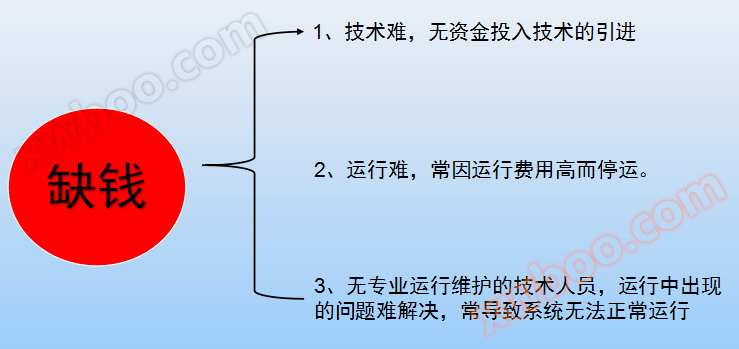
The main challenges in rural sewage treatment

image.png

Photovoltaic electrocoagulation and artificial wetland technology


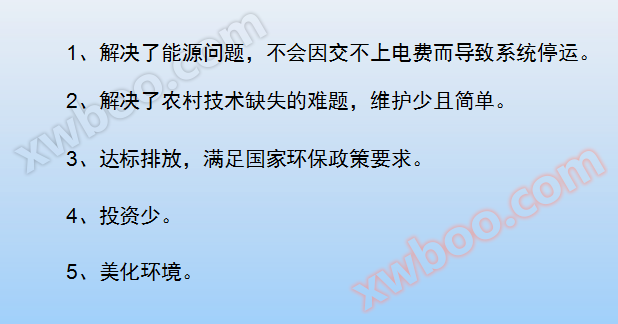
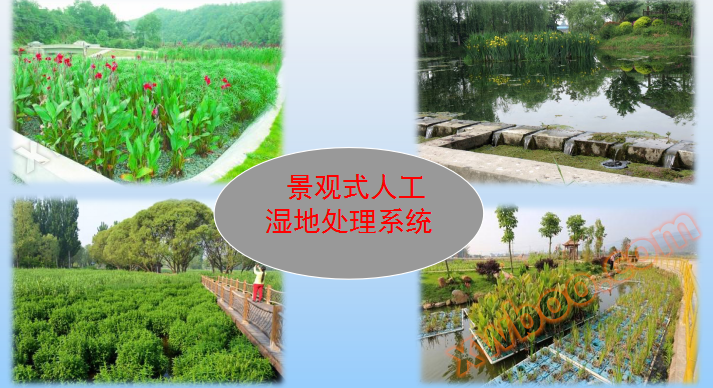
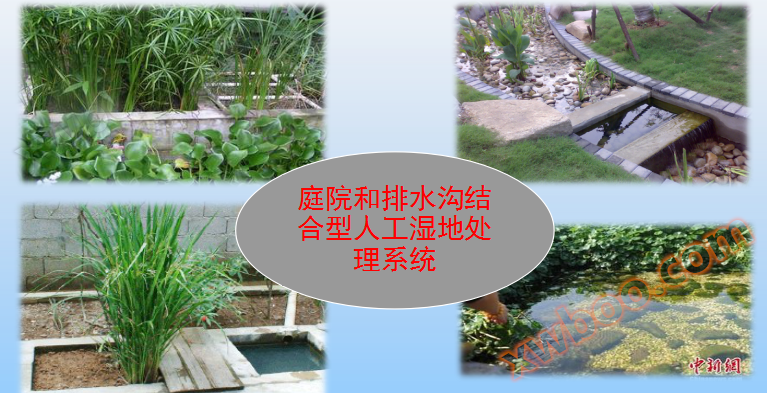
Advantages of photovoltaic electrocoagulation and artificial wetland technology processes

image.png

image.png

image.png

Applicability of photovoltaic electrocoagulation and artificial wetland technology

1. Centralized sewage treatment in rural areas.
2. Decentralized sewage treatment for rural individual investors.
3. Places with abundant sunshine all year round can directly use photovoltaic power supply, while places with insufficient sunshine can use a combination of photovoltaic and mains power.

Application examples

Project Overview:
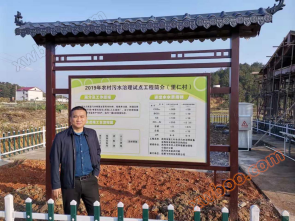
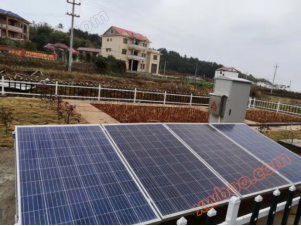
The project is located in Liren Village, Wugang City. The main content is one sewage treatment station with a processing capacity of 50 tons/day, and the water quality meets the Class A standard of the "Pollutant Discharge Standards for Urban Sewage Treatment Plants" (GB18918-2002). The project adopts a mature and stable process of electrocoagulation, anaerobic treatment, and artificial wetland. It operates in a foolproof manner, is easy to manage, does not require dedicated personnel to be on duty, has low power consumption (photovoltaic power supply), and does not generate sludge. The decentralized (single unit, multi unit) and centralized (building, village centralized) treatment modes can perfectly meet the basic situation of various rural areas in China today.

image.png

image.png

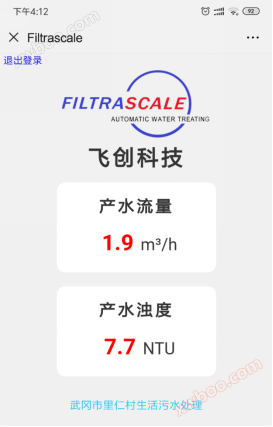
Real time monitoring of cloud control system

image.png