-
E-mail
3191390964@qq.com
-
Phone
15231713135
-
Address
No. 106 Xuefu Street, Cangzhou City, Hebei Province
Product Categories
Hebei Zhongke Beigong Experimental Instrument Co., Ltd


New Asphalt Standard JTG3410-2025 Softening Point Automatic Tester
NegotiableUpdate on 01/07
- Model
- Nature of the Manufacturer
- Producers
- Product Category
- Place of Origin
Overview
The new standard JTG3410-2025 automatic softening point tester for asphalt is based on the global method to determine the softening point of viscous petroleum asphalt. Suitable for determining the softening point of road petroleum asphalt, polymer modified asphalt, liquid petroleum asphalt, coal tar pitch distillation residue or emulsified asphalt evaporation residue, this instrument is the preferred instrument for highway, bridge construction and research institutions. It complies with the standards of the People's Republic of China (GB/T4507-2014); lt; Determination method for softening point of petroleum asphalt; gt; GT and the mandatory industry standard TG3410-2025 of the People's Republic of China; lt; Test Code for Asphalt and Asphalt Mixtures in Highway Engineering; gt; gt;
Product Details


1、 Product Overview
New Asphalt Standard JTG3410-2025 Softening Point Automatic TesterIt is based on the H-ball method to determine the softening point of viscous petroleum asphalt. This instrument is suitable for determining the softening point of road petroleum asphalt, polymer modified asphalt, liquid petroleum asphalt, coal tar pitch distillation residue or emulsified asphalt evaporation residue. It is the preferred instrument for highway, bridge construction and research institutions. This instrument complies with the requirements specified in the People's Republic of China standard (GB/T4507-2014)<<Petroleum Asphalt Softening Point Determination Method>and the mandatory industry standard TG3410-2025<<Highway Engineering Asphalt and Asphalt Mixture Test Regulations>>T0606-2025<<Asphalt Softening Point Test>(new standard) of the People's Republic of China.
2、 Main features:
1. 4.3-inch LCD touch screen display: rich and centralized clock display, current temperature display, timing display, heating process display, test result display, function selection keyboard, etc., with high integration and simple operation. 2. Microcomputer CPU control, precise heating rate, meeting the requirement of 5+O.5C/min. The heating rate of the instrument is automatically calculated by the CPU based on the rate of water temperature rise per minute. After the test is completed, the equipment automatically displays and records the test results. 3. Laser scanning detection, when the steel ball falls, the instrument will automatically detect and lock the temperature of the steel ball falling to the bottom plate, and automatically calculate the average temperature, avoiding errors caused by manual calculation, making the detection data more accurate and the operation simpler. 4. The instrument adopts a German imported microcrystalline glass carbon crystal ceramic electric heating plate with magnetic stirring, and the temperature control method adopts glass blood bottom heating, which meets the requirements of the new industry standards. The instrument uses the PID intelligent control mode of the microcontroller to achieve the test requirement of a water temperature rise rate of 5.0
0.5C/min5、 The instrument has two testing modes, high and low temperature, which can be switched through settings. When the softening point is 80 ° C, water or purified water is required as the medium to reach and stabilize the heating rate at 50.5 ° C/min within three minutes. When the softening point is 80 ° C, glycerol is required as the medium to reach and stabilize the heating rate at 5+0.5 ° C/min. 6. The instrument has magnetic stirring function to ensure uniform water temperature in the glass dish, and the stirring speed can be adjusted. The instrument is equipped with a high-precision speed measurement device, which can display the speed of magnetic stirring (r/min) in real time.
7. Printing function: The instrument can be equipped with a printer, which can print the heating rate and test results throughout the entire test process after the test is completed. 8. Networking function: The instrument can be equipped with a network information transmission system, which can upload test information and results in real time through Ethernet cables, facilitating remote monitoring of the test process and results.
3、 Main technical indicators
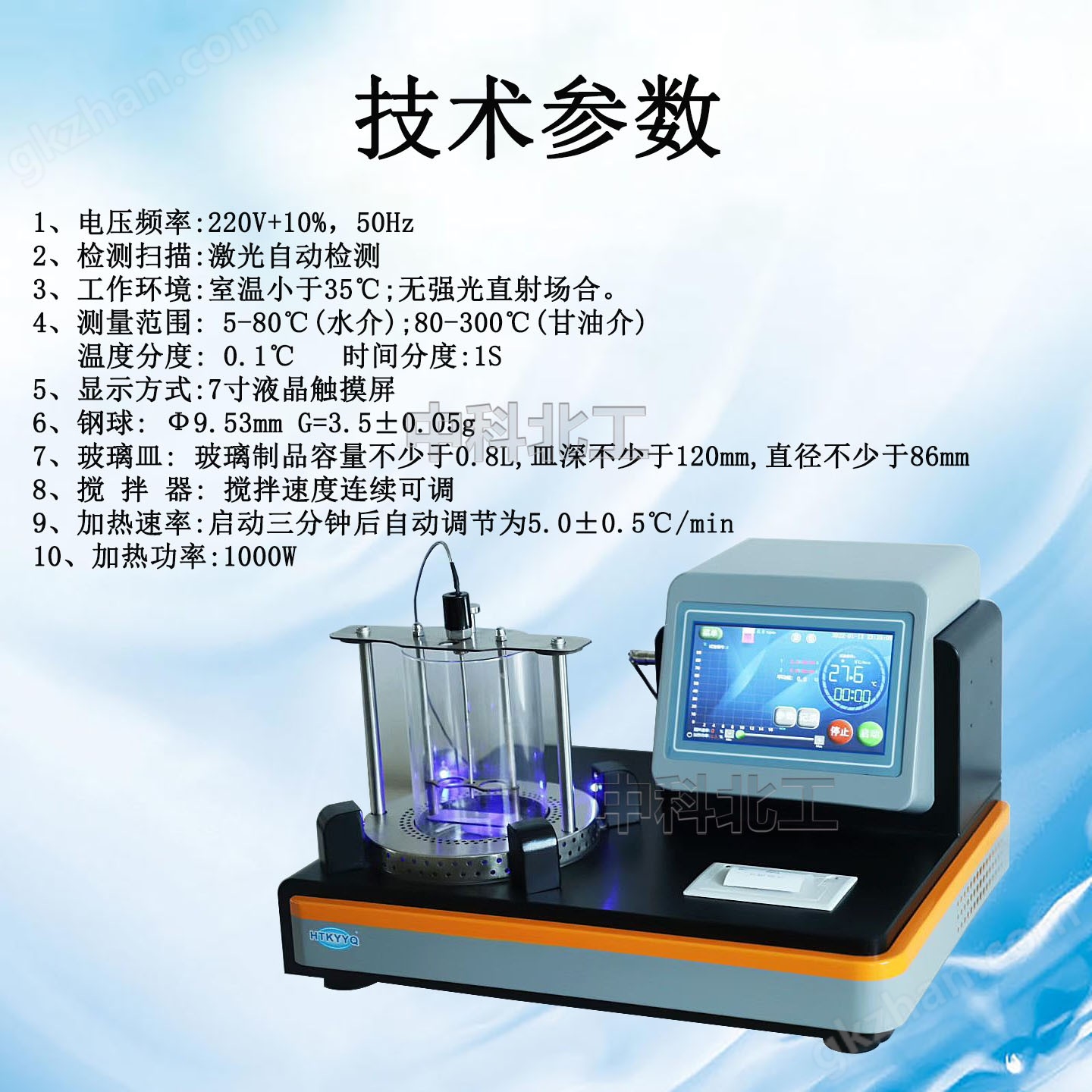
1. Voltage frequency: 220V+10%, 50Hz;
2. Working environment: Room temperature less than 35C; no direct sunlight exposure
3. Measurement range: 5-80C (water medium); 80-300C (glycerol, silicone oil or other medium)
4. Temperature accuracy: minimum division of 0.1C;
5. Time accuracy: minimum division of 1S;
6. Display: 7-inch LCD touch screen display;
7. Detection scanning: laser automatic detection
8. Steel ball: 9.5mm G=3.50.05g;
9. Beaker: glass product capacity not less than 0.8L, dish depth not less than 120mm, diameter not less than 86mm; 10. Stirrer: continuously adjustable stirring speed (using Japanese Shinano motor, accurate counting, long service life);
11. Stirring element: Medium 8xL40mm
12. Mixing speed: 0-500r/min (continuously adjustable)
13. Heating rate: automatically adjusted to 5.00.5C/min after three minutes of start-up;
14. Heating power: 1000W;
15. Heat dissipation fan: 12V0.18W (two sets of Taiwan, China Delta axial flow fans are used)
4New Asphalt Standard JTG3410-2025 Softening Point Automatic Testerinstrument structure
The instrument control part includes: display screen, heater system, infrared detection device, speed control system, microcontroller control system, power supply system, front panel and rear panel, etc;
The instrument testing part includes: beaker, heating tube, temperature sensor, sample ring, steel ball positioning ring, etc. Rear panel: The power interface is connected to a 220V/5OHz AC power supply through a power cord, the heating interface is connected to the heating tube of the tester through a heating wire, the temperature interface is connected to a temperature sensor, and the data transmission network port is connected. 5、 Test method
(1) Preparation and placement of samples
1. Sample preparation: Prepare two samples according to the methods specified in national standards or T0602 regulations.
2. Carefully place the two specimens into the two specimen rings of the testing apparatus.
3. Cover the steel ball positioning ring on the two sample rings and place the two steel balls in the Y hole position of the positioning ring.
4. Fix the left and right pillars into the screw holes on both sides of the workbench.
5. The distilled water level in the beaker is close to the water level mark on the column.
6. Place the magnetic stirrer in the middle of the bottom of the beaker
7. Place the testing rack into the beaker and position it with the left and right pillars.
(2) Connect
Connect the connecting wire between the control body and the testing instrument, with one end of the heating wire connected to the heating interface and the other end connected to the heating tube electrode. One end of the temperature sensor is connected to the temperature interface, and the temperature measuring end is placed in the probe hole of the terbium cross rhodium test instrument. Plug in the power cord.

Similar Product Recommend