-
E-mail
tongpeng@sgnprocess.com
-
Phone
19941878703
-
Address
2nd Floor, Building 2, Zone 5, No. 90 Zhaoxi Road, Shaxi Town, Taicang City
Product Categories
Taicang Xide Machinery Technology Co., Ltd


Vacuum emulsifying homogenizer for cosmetics, pharmaceuticals, and food products
NegotiableUpdate on 01/07
- Model
- Nature of the Manufacturer
- Producers
- Product Category
- Place of Origin
Overview
The specialized vacuum emulsifying homogenizer for cosmetics, pharmaceuticals, and food products mainly refers to the use of a high shear homogenizer to quickly and uniformly distribute one or more phases into at least one continuous phase (water phase, oil phase, powder, etc.) in a vacuum state. With the strong dynamic energy brought by machinery, the material is subjected to hundreds of thousands of high-speed shear, centrifugal extrusion, impact, tearing, and other comprehensive effects per minute in the gap between the stator and rotor. It instantly and uniformly disperses and emulsifies the material, and after high-frequency cyclic reciprocating, finally obtains high-quality products with no bubbles, fine texture, and stability.
Product Details
Introduction to Emulsification Process in Cosmetics and Pharmaceutical Industry
Emulsification process is a core technology in the preparation of cosmetics and pharmaceutical products, mainly used to form stable emulsions (such as O/W or W/O type) by emulsifying immiscible oil phases (such as fats) and water phases (such as glycerol solutions) through emulsifiers or special techniques.
Common methods include:
Phase transition emulsification method: Change the type of emulsion by gradually adding water, and finally form the target lotion.
D-phase emulsification technology: Use non-ionic surfactant and polyol to form gel phase, and then dilute to obtain nanometer lotion, which has the advantages of low energy consumption and small particle size.
Microbial emulsification technologyNatural emulsification is achieved by fermenting biomacromolecules in plant raw materials, without the need for traditional emulsifiers
Industry technical difficulties
JdPhysical property treatmentDifficulty in mixing high viscosity or non Newtonian fluids requires optimization of equipment design (such as colloid mills, homogenizers).
Stability control: Ordinary lotion is easy to delaminate, and its stability needs to be improved through emulsifier selection (such as HLB value matching) or process improvement (such as D-phase emulsification)
.Scaling up production challengesDifficulty in adjusting parameters from laboratory scale to industrial scale, requiring reliance on CFD simulation or intelligent sensing technology.
Natural emulsification limitationsTraditional emulsifiers may affect product safety, while microbial emulsification technology, although innovative, faces challenges in strain screening and process optimization.
development trend
Intelligence and GreeningIntelligent sensing controls the production process, and biological fermentation technology reduces chemical additives.
Cross border technology integration:Computer simulation (CFD) optimizes equipment design to improve mixing efficiency.
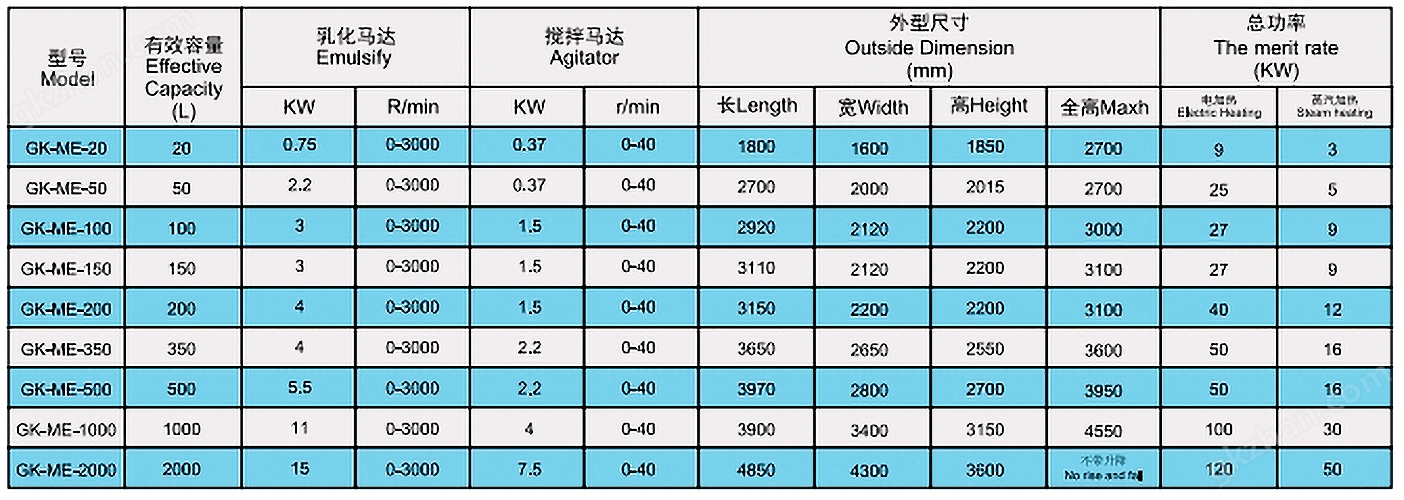
To solve industry difficulties, we recommend our companyVacuum emulsifying homogenizer for cosmetics, pharmaceuticals, and food productsGK-ME。
(1)Definition of vacuum homogenizer emulsifier:
Emulsifier mainly refers to the use of a high shear homogenizer to quickly and uniformly distribute one or more phases to at least one other under vacuumIn the continuous phase (water phase, oil phase, powder, etc.), the strong kinetic energy brought by machinery is utilized to subject the material to hundreds of thousands of high-speed shearing, centrifugal extrusion, impact tearing, and other comprehensive effects per minute in the gap between the stator and rotor. It instantly disperses and emulsifies uniformly, and after high-frequency cycling, it finally obtains high-quality products that are bubble free, delicate, and stable.
(2)Vacuum emulsifying homogenizer for cosmetics, pharmaceuticals, and food productsMain components of the system:
uHydraulic lifting system (one key lifting, one key lowering)
uHeating constant temperature system (electric heating)/Steam heating)
uSlow mixing function (frame scraping wall scraping bottom mixing)
uHomogenization and emulsification function (high-speed shear homogenization head)
uVacuum system (with a vacuum degree of up to-0.095MPA)
(3)Performance and characteristics of vacuum homogenizer emulsifier:
uHomogenization function is generally divided into: lower homogenization, upper homogenization, and internal and external circulation homogenization (can be selected according to the production process)
uThe stirring function is generally divided into: one-way frame scraping wall stirring, two-way frame scraping wall stirring, and screw belt one-way (two-way) frame stirring
uMixing and homogenization are regulated by imported frequency converters to meet the requirements of different production processes
uThe homogeneous structure of German technology, with customizable rotational speed and a maximum shear fineness of up to 2um-5um
uVacuum defoaming enables materials to meet aseptic requirements, and vacuum suction (water, oil, powder) can be used
uLordThe lid of the pot can be raised and lowered for easy cleaning, and the pot body can be poured and discharged
uThe pot has a three-layer stainless steel structure with mirror polishing,talismancombine, synthesizeGMP requirements.
(4) Emulsifier safety protection system:
uVacuum cannot lift the lid of the pot.
uThe lid cannot be lifted when stirring.
uMixing cannot be started when the lid is raised or not fully covered.
uPouring without resetting, the lid cannot rise or fall.
uThe lid of the pot has not been raised to the highest point, making it impossible to pour out the pot body.
uMixing, homogenization overload, or automatic shutdown due to overvoltage in the power grid.
uWhen the steam pressure in the interlayer of the pot exceeds the set pressure, it will automatically drain.
uWhen the pressure of the main boiler cooling water entering the interlayer exceeds the set pressure, it will automatically drain.
uThere will be a buzzing alarm when the main pot crossbeam rises and falls.
uThe electronic control system is equipped with an emergency stop button to immediately stop in case of an emergency.
uSafety signs (in both Chinese and English) are affixed to equipment racks, electrical boxes, and prominent areas for operation
Similar Product Recommend


