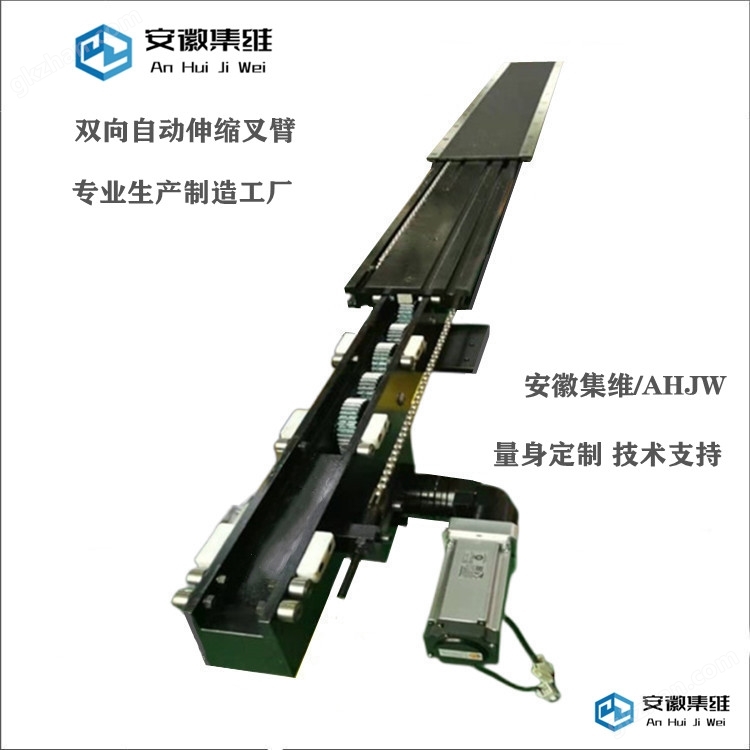
The three section telescopic fork, also known as the three-level telescopic fork, is a core component in intelligent warehousing and automated logistics systems. It is often used in conjunction with stacker cranes, AGVs, and other equipment. Compared to the two-level telescopic fork, it can achieve longer travel and larger loads, and is suitable for medium to heavy and long-distance material handling needs.
Product Details

core structure
The overall structure adopts a three segment nested structure of "lower fork body (fixed fork body)+middle fork body+upper fork body (front fork body)", combined with various auxiliary components to form a complete telescopic mechanism. The specific composition is as follows:
Main fork bodyThe lower fork body is directly rigidly connected to the stacker mounted cargo platform or AGV body, and is the load-bearing foundation of the entire fork; The middle fork is located in the middle layer, playing a transitional role in transmitting power and extending travel; The upper fork body is the executing component that directly contacts the material, and the front end is often designed with a guiding structure to facilitate precise insertion into the tray or bin.
Auxiliary componentsIncluding guide rollers and guide sliders to reduce friction during fork expansion and contraction; Gears, racks, sprockets, and chains are responsible for power transmission; At the same time, it is equipped with limit switches, center switches to control the telescopic stroke, torque limiters, encoders to ensure safe operation and positioning accuracy, and driving components such as motors and reducers to achieve stable operation.
Classification and Working Principle
classificationAccording to the operating mode, it can be divided into single column and double column. Single row structures are mostly single arm structures, suitable for heavy and large materials such as molds, vehicle frames, etc; Double row type is composed of two or more fork arms that operate synchronously, suitable for small and medium-sized lightweight materials such as electronic components, food packaging, etc.
working principleDuring homework, the lower fork is fixed and stationary, while the middle fork is driven by gears, racks, or chain wheels to move outward by about half of its own length. Then, the upper fork continues to extend outward from the midpoint of the middle fork, ultimately reaching the target stroke for material retrieval and placement. When retrieving, it will be reset in reverse order, and the entire process can be precisely automated through the control system.
Key Performance and Parameters
load capacityCovering multiple specifications including light, medium, and heavy, conventional models can have a rated load of several tons, while heavy-duty models are forged from 42CrMo carbon steel, with a maximum load of 15 tons. Lightweight aluminum alloy models can also be selected for light load scenarios.
Travel and AccuracyThe telescopic stroke is usually between 1.2m and 3.5m, and some extended range models can meet longer distance requirements; In terms of positioning accuracy, the chain combination transmission type has a precision of about ± 2-3mm, while the pure gear transmission type has a higher precision of up to ± 0.5mm, which can meet the requirements of high-precision operations.
operational efficiencyThe no-load speed can reach 60m/min, and the full load speed is generally between 30-40m/min. The no-load acceleration is about 1m/s ², and the full load acceleration is about 0.5m/s ², balancing efficiency and operational stability. In addition, the deflection under no-load conditions is ≤ 2mm, ensuring that materials are not tilted or detached during material handling.
Common materials and customization types
Conventional materialsThe mainstream use of 42CrMo carbon steel, after forging and processing, balances strength and toughness; Aluminum alloy can be selected for light load scenarios; 316L stainless steel material can be customized for special environments, suitable for high temperature, low temperature, dust-free and clean working conditions.
custom typeIn addition to conventional models, there are also high-temperature resistant models suitable for high-temperature furnace operations, low-temperature resistant models suitable for cold storage scenarios, anti-static and clean models suitable for lithium battery drying rooms or semiconductor workshops, etc. The structure and materials can be adjusted according to the special needs of different industries.
Typical Applicable Scenarios
Three level telescopic forkIt has a wide range of application scenarios and is the core adaptive component of automated logistics. In the three-dimensional warehouses of e-commerce and retail, cooperate with stacker cranes to complete the storage and retrieval of pallet goods on high-rise shelves; In the field of new energy, lithium battery cells, modules, and photovoltaic modules can be transported, and some explosion-proof customized models can also be used for battery energy storage systems; In the automotive manufacturing industry, it is used to transport heavy materials such as automotive parts and body frames; It is also applicable to automated production lines and logistics transfer centers in industries such as food and beverage, medical equipment, and tobacco.
Mainstream manufacturer models
Manufacturers often name their products based on their own product systems, and model parameters are often associated with core indicators such as load and size. For example, Anhui Jiwei Intelligent's AHJW seriesThree level telescopic forkIt covers multiple specifications and can be customized according to users' load requirements, work schedules, etc., to adapt to different scenarios of stacker cranes, AGVs, and other equipment.