-
E-mail
1339639788@qq.com
-
Phone
13918107979
-
Address
Building 1, National Science and Technology Park, Shanghai University of Technology, 128 Xiangyin Road, Shanghai
Product Categories
Shanghai Ruicheng Electric Co., Ltd


Localization of school digital clock system
NegotiableUpdate on 01/07
- Model
- Nature of the Manufacturer
- Producers
- Product Category
- Place of Origin
Overview
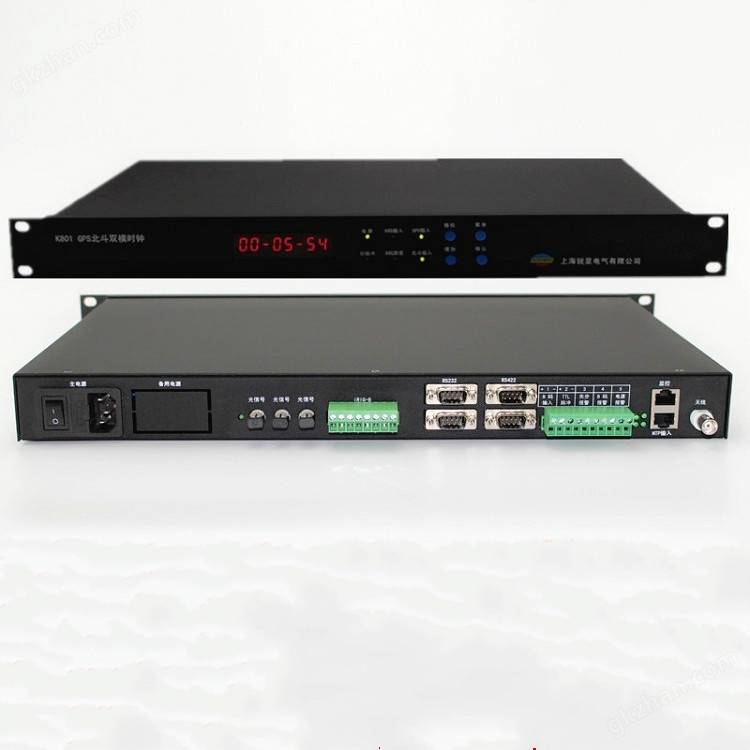
The localization of the school digital clock system consists of a central master clock, multiple slave clocks, and monitoring software. Under normal operation of the system, the master clock continuously calibrates its internal clock accuracy with GPS or Beidou satellite time signals, and sends precise time signals to sub clocks and other weak current system equipment that require standard time signals in various regions through the transmission system (network, 485 bus), achieving time uniformity of the entire network.
Product Details
1、Localization of school digital clock systemIntroduction
Localization of school digital clock systemIt is composed of a central master clock, multiple slave clocks, and monitoring software. Under normal system operation, the master clockGPSOr the Beidou satellite time signal continuously calibrates its internal clock accuracy through the transmission system (network485The bus sends precise time signals to sub clocks and other weak current system devices that require standard time signals in each area, achieving time synchronization of the entire network.
2School Digital Clock System (Digital Clock)Technical Specifications
Working voltage:AC220V±20%,50Hz±10%orPOEpower supply
Average power consumption:3W~30W(Determined by the size of the digital tube, single-sided and double-sided display, and display content)
Timing accuracy:≤1mS
Self travel time accuracy: ≤±0.05second/sky
LEDDisplay screen luminous intensity:≥200cd/m2
contrast≥10:1
LEDDisplay viewing angle≥±75°
MTBF:≥150000hour
Average repair time(MTTR)Generally not greater than30minute
The service life shall not be less than20Under normal usage conditions, no maintenance is required
3Reference standards for school digital clock systems
Shanghai Ruicheng Electric Co., Ltd. strictly adheres to relevant standards and technical specifications in the development and production of sub clocks, and combines them with actual situations according toISO9001According to the requirements of the international quality certification system, corresponding enterprise standards and production processes should be formulated to better meet the requirements of users.
The design, manufacturing, testing, installation, debugging, and operation of the equipment comply with the current national and industry standards in China, including:
Code for Construction and Acceptance of Electrical Equipment Installation Engineering GB 50254-96
Analog quartz clock standard GB/T6046-1992
General Technical Conditions for Coating of Appearance Parts of Timing Instruments and Coating Layer of Clock Metal Appearance PartsZBY 11011-86
Equipment Reliability Test Specification GB50807-86
Electromagnetic compatibility testing and testing techniques GB/T17626-1998
Design Specification for Electronic Computer Room GB 50174-93
Design Specification for Integrated Cabling System Engineering GB 50311-2007
Code for Electrical Design of Civil Buildings JGJ/T 16-92
Design Specification for Digital Synchronous Network Engineering YD/T 5089-2005
Design Specification for Indoor Coverage Engineering of Wireless Communication Systems YD/T5120-2005
Protection against lightning electromagnetic impulse IEC61312-95
Industry Standards of the People's Republic of China QB—1038 1042—91
4Classification of School Digital Clock Systems
Ethernet wired access to the central master clock orNTPThe time server obtains standard time, and this type of sub clock is referred to as network sub clock orNTPZi Zhong.
WIFIWireless access to the central master clock orNTPThe time server obtains standard time, which is abbreviated as this type of sub clockWIFIZi Zhong.
CDMA(4G)Wireless reception of signals from China Telecom base stations to obtain standard time, referred to as this type of sub clockCDMA(4G)Zi Zhong.
RS485The bus method obtains the standard time of the central master clock, which is abbreviated as this type of sub clock485Zi Zhong.
From the perspective of display content, sub clocks are divided into digital sub clocks and analog sub clocks.