The global manufacturing industry is moving from "automation" to "intelligence".
With the acceleration of technologies such as big models and generative AI entering the manufacturing scene, industrial systems are evolving from a control centric approach to a collaborative approach of perception, analysis, decision-making, and optimization. At the same time, data has gradually become an important production factor driving production optimization from recording the production process.
This means that the underlying industrial control system that supports the intelligent operation of industry also needs to be upgraded synchronously.
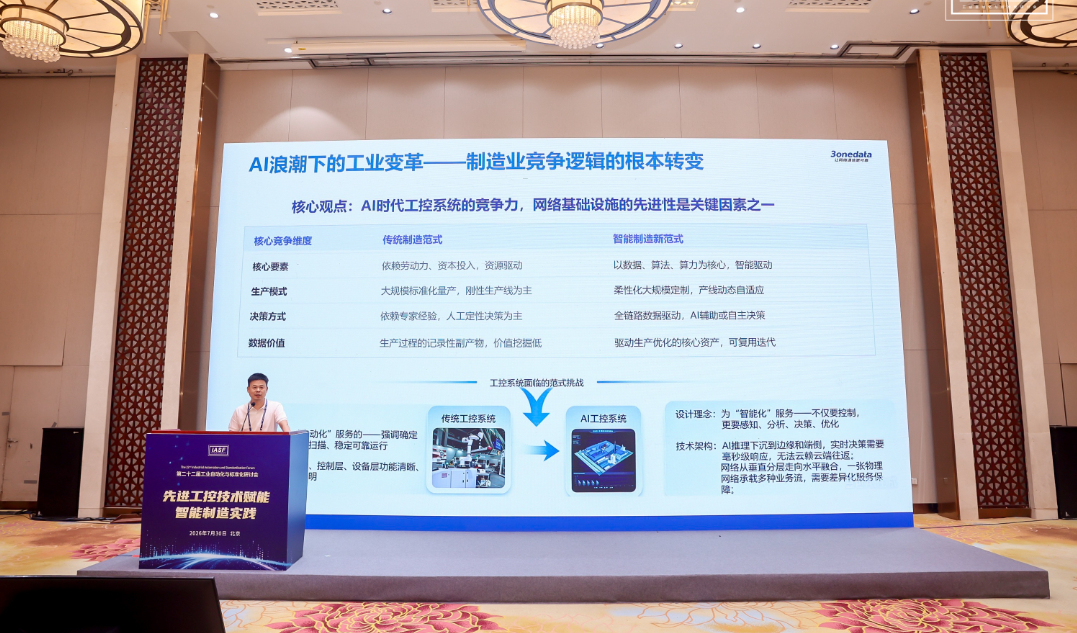
Recently, the 22nd Industrial Automation and Standardization Symposium (IASF) was held in Beijing. The theme of this conference is "Construction and Practice of New Generation Intelligent Manufacturing System", focusing on the development of key technologies in industrial automation, industrial communication, and intelligent manufacturing.
As a company that has been deeply involved in the field of industrial interconnection for more than 20 years, Sanwang Communication was invited to attend and deliver a keynote speech titled "New Base of Industrial Control Systems in the AI Era - Edge Network Integration" at the "Advanced Industrial Control Technology Empowering Intelligent Manufacturing Practice" forum, sharing the technological evolution and practical thinking of industrial control systems in the AI era.
From "automation" to "intelligence", the industrial control base needs to be restructured
Traditional industrial control systems emphasize deterministic periodic scanning and stable operation, while industrial systems in the AI era require further collaboration between data perception, intelligent analysis, real-time decision-making, and control execution.
The end, edge, and network are no longer independent functional modules, but need to form a unified system.
Sanwang Communication believes that the key to end-to-end network integration is not simply stacking devices, but requires a set of deterministic collaborative mechanisms that run through it. The new industrial network technology represented by Time Sensitive Networks (TSN) is an important underlying support for this system.
Based on mechanisms such as time synchronization and deterministic scheduling, TSN can enable industrial networks to have predictable transmission capabilities and further support the synergy of time, data, and computing power
Time collaboration, allowing different devices to be on a unified and accurate time reference;
Data collaboration enables deterministic transmission of data of different priorities within the same network;
Collaborative computing power enables more efficient coordination of data and computing resources between the end, edge, and cloud.
As a result, industrial networks are evolving from "multi network coexistence" to a more unified, open, and deterministic network system, providing underlying support for new applications such as industrial AI.
Using TSN as the core, it runs through the end, edge, and network
Centering on the technology core of TSN, Sanwang Communication has continuously promoted the extension of deterministic network capabilities to different industrial communication scenarios, forming a technical layout from field connection to edge computing, and from wired network to wireless communication.
In the field of process industry, Sanwang Communication continues to promote the integration of APL+TSN.
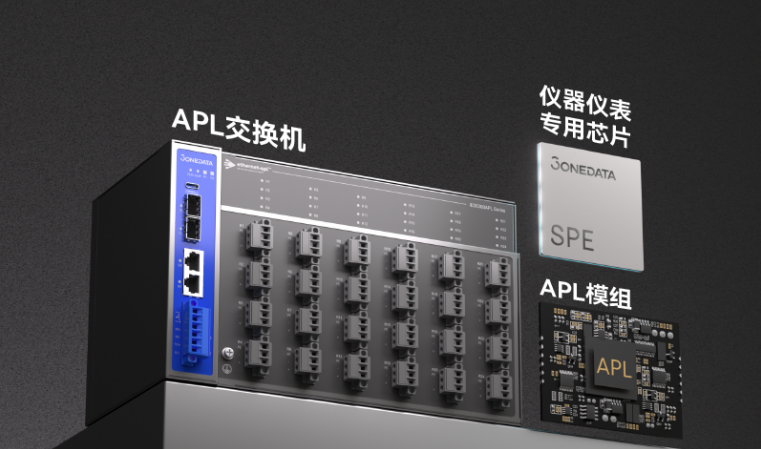
At the conference, Sanwang Communication highlighted the APL process industry solution. At present, a product system covering APL switches, APL modules, PROFINET over APL, and APL full stack solutions has been formed, and TSN technology has been further integrated to achieve network connectivity from field instruments, control layers to management layers, providing a new technological path for the evolution of process industry field networks to industrial Ethernet.
On the wireless and edge side, Sanwang Communications further explores the integration direction of TSN+5G, TSN+edge computing, and extends the deterministic network capability to wireless connection and edge computing nodes.
From field access, wireless transmission, to edge computing and industrial control, TSN is gradually becoming the underlying capability through different connection modes and computing nodes from a single network technology, promoting the industrial network from "connecting devices" to "collaborative systems".
Supporting a new foundation for intelligent manufacturing with deterministic networks
From the era of deterministic networks to the era of intelligent integration, industrial infrastructure is undergoing new technological evolution.
Sanwang Communications continues to take TSN as the core, promote the integration of APL, 5G, edge computing and other technologies, and extend the certainty capability to all aspects of the end, edge and network with a complete industrial network product and solution system.
The core of this layout is not to add more isolated technologies and products, but to enable the orderly flow of data in industrial sites, allowing networks, computing power, and control to truly collaborate, providing a reliable foundation for AI to enter production systems.
At present, Sanwang Communication has built a product system covering industrial wired networks, industrial wireless networks, industrial data collection and edge gateways, industrial control and other fields, and continues to promote the application of TSN technology in intelligent manufacturing, rail transit, energy and power, process industries and other scenarios.
In the future, Sanwang Communications will continue to deepen independent innovation around key technologies such as TSN, SPE, APL, 5G and edge computing, promote the deep integration of new industrial networks and intelligent manufacturing, and continue to consolidate the network base of industrial control in the AI era.