- Phone
-
Address
101, Building 1, No. 199 Jiangkai Road, Minhang District, Shanghai
Product Categories
Shanghai Wenyi Optoelectronics Technology Co., Ltd
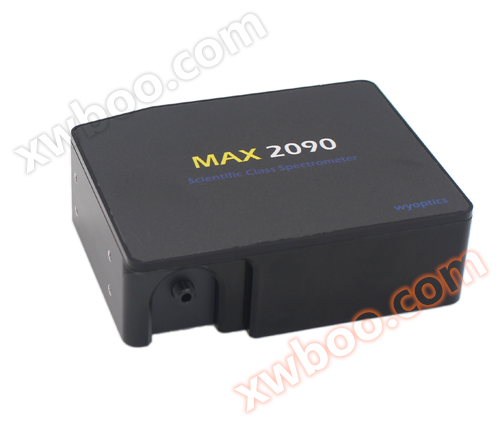
MAX2090 | Fiber Optic Spectrometer
NegotiableUpdate on 03/26
- Model
- Nature of the Manufacturer
- Producers
- Product Category
- Place of Origin
Overview
MAX2090 | Fiber Optic Spectrometer
Product Details
Hamamatsu array back illuminated CCD/high UV response/185~1100nm full spectrum
The MAX2090 spectrometer adopts Hamamatsu surface array back illuminated CCD, which has several times higher UV sensitivity and high signal-to-noise ratio than commonly used linear array CCD. At the same time, it adopts imported Richardson grating and is equipped with LVF high-order filter. Based on a 60.0mm focal length optical platform, it provides balanced sensitivity and high resolution in the full spectrum of 200-1100nm, making it a spectrometer suitable for various scientific research applications.
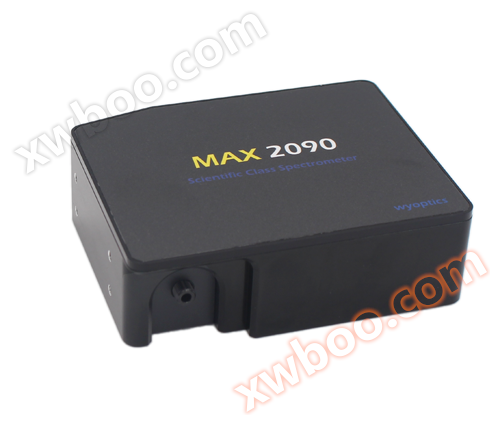
MAX2090 Area Array Back Illumination Spectrometer
The MAX2090 fiber optic spectrometer is mainly aimed at scientific research and industrial users. Its superior sensitivity, thermal stability, high signal-to-noise ratio, and many other advantages have won the trust of customers
1. CCD has a quantization efficiency of 70% in the ultraviolet region and a higher ultraviolet response;
2. By adopting a 60mm focal length CT optical path, the balance between system resolution and sensitivity has been greatly optimized;
3. Using Hamamatsu array back illuminated CCD, 2048 * 64 pixels, with extremely high sensitivity;
4. Adopting imported Richardson grating and equipped with Wenyi photoelectric elimination high-order filter, achieving efficiency balance in the full spectral range of 200-1100nm;
5. To meet the demand for industrial online synchronous detection, real-time synchronous collection can be achieved through USB, serial port, external trigger, etc;
6. We also provide customers with based services NET framework software secondary development toolkit.
| model: | MAX2090 | ||||
| Detection range: | 200~1100nm, depending on the grating | ||||
| Wavelength resolution: | Up to 0.1nm, depending on the grating | ||||
| Optical resolution: | Maximum 0.2nm (FWHM), depending on the grating | ||||
| Detector: | Hamamatsu, 2048 × 64 pixels, area array backlit CCD |
||||
| Eliminate high-order filters: | Eliminate ghost lines in the spectrum | ||||
| Optical platform: | Focal length 60mm, f-number 5, C-T optical path | ||||
| Integral time: | 10ms ~ 65 sec | ||||
| Dynamic range: | 10000:1, more than twice as good as similar products, conducive to weaker signal detection | ||||
| Signal to Noise Ratio: | 1000:1 (when saturated), superior to similar products, smoother spectrum, and more obvious signal | ||||
| Scattered light: | < 0.1% @ 600nm | ||||
| Correction of linearity: | > 99% | ||||
| Fiber optic interface: | SMA905 | ||||
| Data transmission: | USB-B, Supports USB 2.0 communication protocol and 480Mbps transmission speed | ||||
| Expansion function port: | 8-pin expansion function port | ||||
| Collection mode: | Single, continuous, software triggered, synchronous external triggered | ||||
| Size: | 110 × 86 × 35mm³ | ||||
| Weight: | 440 g | ||||
| A/D bits: | 16-bit | ||||
| power waste: | 300mA @ 5VDC | ||||
Typical application areas:
Transmission, reflection, and absorption spectra are the ratio of the sample spectrum to the reference spectrum, which reduces the signal-to-noise ratio of the original spectrum. Therefore, a spectrometer with a high signal-to-noise ratio is required; At the same time, in order to obtain more information, the spectrometer needs to have a wide spectral range.
Fluorescence spectroscopy measures weak fluorescence intensity, which belongs to weak light signals. In order to detect fluorescence spectra, a high-sensitivity spectrometer is generally required.
Microscopic spectroscopy requires the collection of spectral signals at the micrometer scale, which requires the spectrometer to have the ability to detect weak optical signals.
| model | Band range selection (nm) |
Grating number (g/mm) |
Wavelength interval (nm) |
Resolution corresponding to slit width (nm) | |||||
| 10 μm | 25 μm | 50 μm | 100 μm | 200 μm | |||||
| MAX2090 | 200~1100 | 300 | 0.44 | 1.7 | 2.3 | 3.3 | 6 | 12 | |
| MAX2090 | 200~1000 | 500 | 0.39 | 1.1 | 1.4 | 2.4 | 3.5 | 7.5 | |
| MAX2090 | 300~1100 | 500 | 0.39 | 1.1 | 1.4 | 2.4 | 3.5 | 7.5 | |
| MAX2090 | 200~870 | 600 | 0.32 | 1 | 1.2 | 1.9 | 3.3 | 6.7 | |
| MAX2090 | 340~1000 | 600 | 0.32 | 1 | 1.2 | 1.9 | 3.3 | 6.7 | |
| MAX2090 | 450~1100 | 600 | 0.32 | 1 | 1.2 | 1.9 | 3.3 | 6.7 | |
| MAX2090 | 700~1100 | 800 | 0.2 | 0.9 | 1 | 1.5 | 2.5 | 4.5 | |
| MAX2090 | 300~650 | 900 | 0.17 | 0.6 | 0.8 | 1.3 | 2.3 | 4.3 | |
| MAX2090 | 180~400 | 1200 | 0.11 | 0.4 | 0.5 | 0.8 | 1.7 | 3.4 | |
| MAX2090 | 390~610 | 1200 | 0.1 | 0.4 | 0.5 | 0.8 | 1.7 | 3.4 | |
| MAX2090 | 600~810 | 1200 | 0.09 | 0.4 | 0.5 | 0.8 | 1.6 | 3.3 | |
| MAX2090 | 800~1000 | 1200 | 0.09 | 0.4 | 0.5 | 0.8 | 1.6 | 3.2 | |
| MAX2090 | 200~300 | 2400 | 0.05 | 0.2 | 0.3 | 0.4 | 0.8 | 1.2 | |
| MAX2090 | You can also customize the required wavelength according to user requirements | ||||||||


