- Phone
-
Address
206, Building 1, Fortune Center, No. 18 Qinling Road, Laoshan District, Qingdao City, Shandong Province
Product Categories
- 10 types of core scanning sensors @ Geotek
- Suspended solids/sediment/wave dynamics @ Argus Germany
- PH meter/plankton/sediment/sediment
- CO2/methane/total gas @ Pro Oceanus
- Buoy/submersible buoy/seabed foundation/seabed observation network
- MSCL Core Comprehensive Testing @ Geotek
- Optical/Beidou/Iridium/Wireless Telecommunication Standard @ Xeos
- XCT Core 3D Tomography @ Geotek
Qingdao Territorial Sea Marine Instrument Co., Ltd

C-ROM underwater deployment and recycling base
NegotiableUpdate on 04/08
- Model
- Nature of the Manufacturer
- Producers
- Product Category
- Place of Origin
Overview
Small seabed based C-ROM is used for the deployment and recovery of marine instruments on the seabed. The C-ROM system consists of three parts: an underwater bucket shaped float, an acoustic release device, and multiple marine instruments.
Product Details
Small seabed based C-ROM is used for the deployment and recovery of marine instruments on the seabed. The C-ROM system consists of three parts: an underwater bucket shaped float, an acoustic release device, and multiple marine instruments. The main purpose of C-ROM is for the partial and recovery of oceanographic research equipment and various underwater devices, the recovery of anti trawl seabed bases, and the deployment of anchor submersible markers and seabed bases in nearshore areas, rivers, lakes, estuaries, and other places.
ROMOR's C-ROM offers a new concept of underwater anchor measurement solution, providing reliable and compact structural design for anchor measurement and instrument equipment recovery. Equipped with a float and a bracket for fixing measuring instruments, C-ROM and C-ROM plus models offer buoyancy of 36 kg or 48 kg, with a minimum pressure resistance of 750 meters deep, and can be customized up to 6000 meters. Users' release devices and marine instruments can be installed inside the floating body, provided that the size requirements of the floating body are met. The floating body can be equipped with an anchor retrieval system RotoDrum, which brings back the retrieval rope. After the floating body is released and reaches the sea surface, the anchor or heavy object on the seabed can be retrieved through the rope.
Other accessories that can be carried include: real-time acoustic communication system, radio and flashing beacon, and additional float for deepwater models.
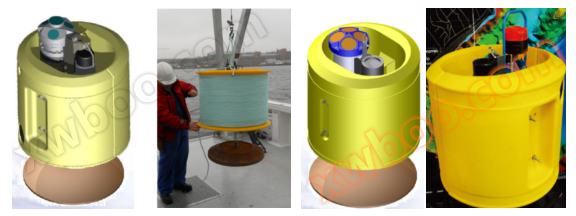
10 technical advantages of C-ROM:
C-ROM greatly simplifies the deployment and recovery of marine instruments. The recycling of C-ROM is very reliable. After the underwater release device is released, valuable instruments and equipment, as well as the release device, immediately surface with the float and are safely recovered; After the traditional method of releasing the floating ball, there is still a risk of loss of underwater instruments and equipment
2. C-ROM provides excellent protection for valuable instruments and equipment: the release device and marine instruments are installed inside the barrel shaped float, protected by the barrel shaped float, and are very safe and not easily damaged at all stages, including installation, transportation, deployment, underwater, and recycling;
3. The purchase cost of C-ROM is low, with a tax-free price of 30000 to 80000 RMB excluding the release device and instrument;
4. C-ROM composite foamed plastic and polyethylene materials are non corrosive for life, with a service life of more than 30 years. They can be put in and recycled repeatedly, without the worry of corrosion of ordinary mounting frames; The number of times it is released and recycled far exceeds that of ordinary underwater installation racks such as stainless steel tripods; The annual cost is significantly lower than that of ordinary shelves;
5. C-ROM can carry a variety of marine instruments, including temperature and tide gauges (such as RBRduo T.D | tide), temperature and salinity depth gauges (such as RBRconcerto C.T.D), multi parameter water quality gauges (RBRconcerto and RBRmaestro), underwater high-definition cameras, ADCPs (such as Nortek Langlong, Yuanlong, and Kuanglong), RDISentinel)、 Wave tide meter, hydrophone, turbidity meter, etc. After the floating body emerges from the water, it can also be equipped with beacons (such as Xeostech LED light beacons, wireless telecommunication beacons, iridium satellite beacons, etc.) and real-time acoustic communication systems for easy searching
The net buoyancy of C-ROM's float is available in two types: 36 and 48 kilograms, suitable for instruments of various sizes. Additional buoyancy can be added for deep-sea applications or overweight instruments.
7. C-ROM is suitable for the deployment of acoustic Doppler current profiler ADCP, because C-ROM has a large net buoyancy and always maintains the ADCP vertically upward (ordinary tripods may tilt on the seabed), which can effectively ensure high-quality velocity profile data and wave height data; If used in high water flow environments, an elliptical C-ROM can be provided, greatly reducing the oscillation and noise caused by the impact and drag of ocean currents.
8. The deployment depth of standard C-ROM is 750 meters, which is suitable for the vast majority of nearshore and continental shelf waters; We can customize deep-sea models for customers: 2500, 3500, and 6000 meters.
9. The C-ROM structure is compact, with a diameter of 63.5 centimeters and a height of 60-66 centimeters. It occupies a small area on the ship's deck and can accommodate 20-30 C-ROMs at a time (as shown in the figure below), reducing deployment costs.
10. The normal mode of C-ROM can prevent ordinary fishing nets. If installed on the bottom trawl base, it can prevent bottom trawling fishing nets and can also come with a retrieval anchor cable (up to 500 meters long) to retrieve the base.

30 sets of C-ROM are ready for deployment, occupying only one corner of the ship deck
Two ways of laying C-ROM:
1. Normal mode (anti ordinary fishing net, not anti bottom trawl): C-ROM+acoustic release device+multiple marine instruments+cement weight block (disposable)
2. Bottom trawl mode: C-ROM+RotoDrum rope reel+acoustic release device+multiple marine instruments+stainless steel bottom trawl seabed base (recyclable)


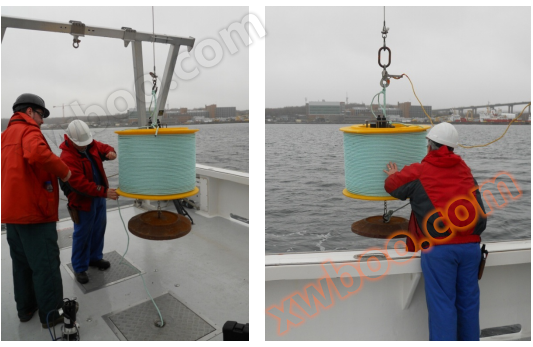
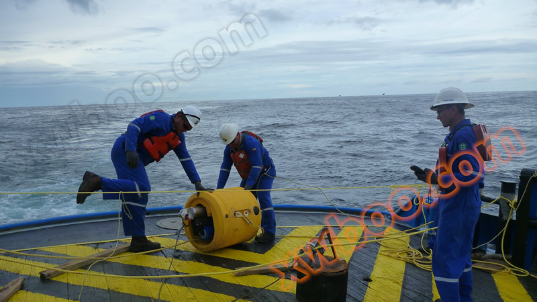
C-ROM is ready to go into the water

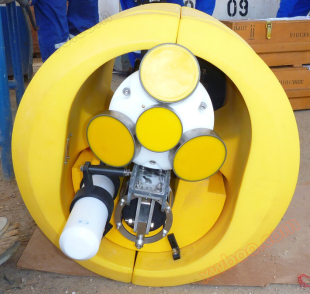
C-ROM is equipped with Nortek Langlong AWAC

C-ROM is equipped with Satlantic's SUNA underwater nitrate meter, CTD temperature salinity depth meter, dissolved oxygen meter, and hydrophone, and is the main equipment of the Canadian Ocean Tracking Network (OTN) project.
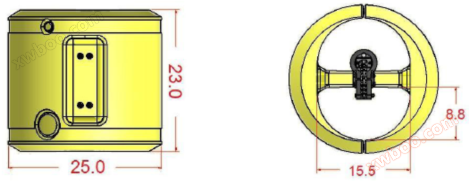
Product Dimension Drawing
Similar Product Recommend


